04 — MagentaGaming
Product changes in days, not months.
Together with my design counterpart, I changed the way product, design and engineering worked around the same problem.
The problem
In a company the size of Deutsche Telekom, even a small product change could take months to reach users.
MagentaGaming was a B2C gaming product backed by a large Romanian–German product organisation with around 40 engineers.
The capacity was there.
The problem was how work moved through the organisation.
Product, design and development operated through sequential handovers. A user problem could be understood quickly, but turning that insight into an actual product change meant moving through several teams, decisions and delivery steps.
By the time something reached production, the original feedback could already be weeks or months old.
The size of the organisation had become part of the lead time.
What I changed
I was a Product Manager in MagentaGaming.
Together with my design counterpart, I changed the way product, design and engineering worked around the same problem.
Instead of treating product definition, design and development as separate stages, we brought those decisions much closer together.
The goal was not to make developers work faster.
It was to shorten the path between:
user feedback → product decision → design → production
and remove as much waiting and translation from that path as possible.
What changed
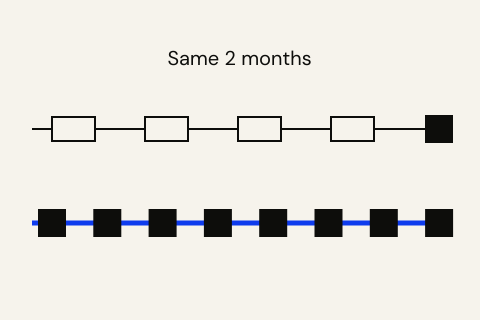
Changes that had previously taken months could reach production within days.
User feedback could become a product decision, a design change and a live implementation within the same week.
That mattered for more than delivery speed.
It demonstrated something I still consider important:
a company the size of Deutsche Telekom can react almost immediately when product, design and engineering are organised around the same problem.
Large organisations are not automatically slow.
The fundamental constraint was not the number of employees, countries or systems involved.
It was how decisions and work moved between them.
Why it worked
We reduced the handovers.
The people responsible for understanding the user problem, deciding what should change, designing the experience and building the change worked much closer together.
That meant questions could be resolved while the work was happening instead of travelling through a chain of functions.
Design could meet technical reality earlier.
Engineering could understand the user problem directly.
Product decisions could be made with both perspectives present.
Less time was spent waiting, translating and reworking.
The speed came from shortening the decision loop, not from asking developers to code faster.
What this proved
Large companies are often treated as if slow product development were simply a consequence of scale.
MagentaGaming showed me that this is only partly true.
Scale creates complexity.
But complexity does not have to mean long feedback loops.
With the right product setup, even a large corporate organisation can:
- understand user feedback quickly;
- decide what matters;
- make a change;
- put it into production;
- and learn from the result within days.
Good product management can turn organisational scale from a delay into a coordination problem that can actually be designed.
But speed was not enough
MagentaGaming was ultimately not a commercial success.
That is an important part of the story.
We improved the organisation’s ability to deliver and respond to users.
That did not automatically make the product valuable enough in the market.
User research and the later post-mortem pointed to deeper issues around the target audience, proposition, content, positioning and the overall customer experience.
So the experience proved two different things at the same time:
A large company can move in days.
And:
moving quickly is only valuable if you are moving towards something customers actually want.
What this changed in my thinking
For much of my earlier career, getting something built had been one of the hardest parts of the problem.
MagentaGaming made another limit very visible.
You can have:
- a capable engineering organisation;
- fast releases;
- close product-design-development collaboration;
- and rapid reactions to user feedback;
and still not have a successful product.
That separated two things for me:
delivery performance and product success.
Improving delivery was necessary.
It was not sufficient.
From there, I became increasingly focused on discovery, user evidence, validating assumptions early and deciding what not to build.
Speed matters most when it reduces the time to learning — not merely the time to release.
Evidence
The original material includes:
- MagentaGaming user research;
- Voice of User findings;
- post-mortem material;
- delivery and release documentation;
- examples of product changes made in response to user feedback;
- evidence of beta and commercial launch across multiple platforms.
What I would not claim
I would not claim that these changes made MagentaGaming commercially successful.
They did not.
And the result was the work of a wider product organisation, not mine alone.
What I can claim is specific:
as Product Manager, working closely with my design counterpart and engineering teams, I changed a product-development flow in which changes had taken months into one where user feedback could reach a live Deutsche Telekom product within days.
And the broader lesson stayed with me:
the size of the company was not the fundamental constraint. The way decisions and work moved through it was.
Next story
Moving AI out of the sandbox.