05 — Excel AI Analyzer
Moving AI out of the sandbox.
My team and I built an AI-powered Excel Analyzer.
The problem
The business data that mattered was often the data AI was not allowed to touch.
Generative AI could already write emails, summarise documents and answer questions.
But much of the data employees actually used to understand and run the business lived in confidential Excel files — or in systems whose data could be exported into Excel.
Financial data. Operational data. Survey results. Reports. Lists. Analyses.
And because that data was confidential, employees could not simply upload it to a public AI service.
That created a fundamental gap:
AI could work on generic information, but not on much of the real business data where it could have been most useful.
We wanted to close that gap.
What I built
My team and I built an AI-powered Excel Analyzer.
The idea came from a simple observation:
if business data already lives in spreadsheets, let people use AI directly on spreadsheets.
A user could upload an Excel file and use AI to analyse its contents, ask questions and identify patterns without first building a dedicated application around every dataset.
The tool itself was not limited to one HR use case. It was designed as a broader way to work with spreadsheet-based business data.
That made the real challenge clear:
could we make the same capability usable with confidential enterprise data?
The first approved confidential-data use case
The scenario we took through approval was employee survey feedback.
The Excel file contained free-text responses. The goal was to identify recurring patterns, group the feedback into categories and weight the themes so the organisation could understand what employees were saying at scale.
AI was particularly useful because the information was not neatly structured into predefined categories.
But this was employee data.
That meant the approval question was not simply:
Can the AI process confidential information securely?
It was also:
What exactly is the AI allowed to do with that information?
Making AI usable meant limiting what it could do
This mattered particularly to employee representatives.
A system able to analyse employee feedback could potentially be repurposed for identifying individuals, profiling employees or measuring individual performance.
That was not acceptable.
So the confidential-data use case was not an open-ended prompt over sensitive information.
The task itself was predefined and approved:
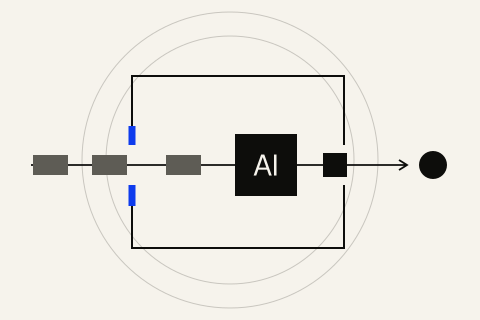
analyse the permitted free-text feedback, identify recurring patterns, group it into categories and help weight those themes at aggregate level.
It was not approved to:
- identify individuals;
- profile employees;
- assess individual performance;
- or perform arbitrary analysis outside the agreed purpose.
The Excel Analyzer was a broader capability. The confidential employee-feedback scenario was deliberately constrained to one approved use.
The limitation was part of the product design.
We were not asking the organisation to approve AI in general.
We were asking it to approve one specific capability, for one defined purpose, with explicit boundaries.
What changed
This became Deutsche Telekom’s first approved use of AI on confidential data.
But the more important change was what that approval demonstrated.
We moved AI from generating and analysing generic content towards working with actual business data — including data that had previously been off limits.
Confidentiality did not automatically have to exclude AI.
Employee representation did not automatically have to stop the use case.
Security and governance did not have to arrive after the product was built.
Those constraints could become product requirements from the beginning.
The breakthrough was not getting permission to use AI on sensitive data. It was designing the use narrowly enough that the organisation could safely approve exactly what the AI was allowed to do.
Beyond one use case
The Excel Analyzer was part of a broader effort to make AI usable for real business work.
We also built a locally running AI chatbot for scenarios where data could not leave the controlled environment, and HR prototypes built around specific business problems rather than generic chat.
The common principle was the same:
start with the work and its constraints, then choose how AI should fit into it.
What this proved
We did not prove AI at scale.
We proved a path from experimentation towards controlled, approved business use.
The data is confidential.
→ Control where and how it is processed.
The technology could be misused.
→ Restrict sensitive use cases to predefined and approved tasks.
A generic chatbot is not enough.
→ Design AI around a specific business problem.
Security, privacy and employee representation may object.
→ Make those requirements part of the product from the beginning.
What this changed in my thinking
AI made an old pattern in my work much more visible.
The technology itself is rarely the whole problem.
A powerful capability may already exist and still create little value because it has not yet been connected to the right problem, the right workflow, the right boundaries and a way the organisation can actually use it.
That is why I became less interested in “AI solutions” as a category.
The more useful question became:
Where is there a meaningful problem that AI now makes newly solvable — and what has to be true for the organisation to use it safely?
Evidence
The original work includes:
- the Excel AI Analyzer;
- the approved confidential-data employee-feedback use case;
- the local AI chatbot;
- HR AI prototypes;
- AI-assisted analysis and feedback tools;
- workshop and strategy material;
- security, privacy and governance work around the solutions.
What I would not claim
I would not claim broad AI adoption or a large measured business impact from this work.
Much of it was experimentation, prototyping and removing barriers to future use.
Several solutions remained prototypes rather than scaled production products.
What I can claim is specific:
my team and I built an AI tool for analysing real spreadsheet-based business data and established Deutsche Telekom’s first approved use of AI on confidential data — showing that sensitive enterprise AI could move beyond experimentation when the purpose, safeguards and limits were designed into the product itself.
Next story
Expertise that scales.